
Assumptions

Author’s Note: I started writing this piece a month ago, so some references may be outdated.
I was having a conversation with a mentor this week, about assumptions. “The thing you need to figure out”, he said, “is why some people always get the benefit of the doubt”. You know, the people who can say “we choose truth over facts” in a public speech. Or flub up migrations on a database but continue to be consulted on every project. Like, “What is the difference between people who receive the best of assumptions and people who do not?”
My facetious answer is, well, try not to be famous.
Sabrina Carpenter was on SNL last night. She was in every skit and I watched every one of them. She was also, recently, the target of mass criticism for her Man’s Best Friend album cover.
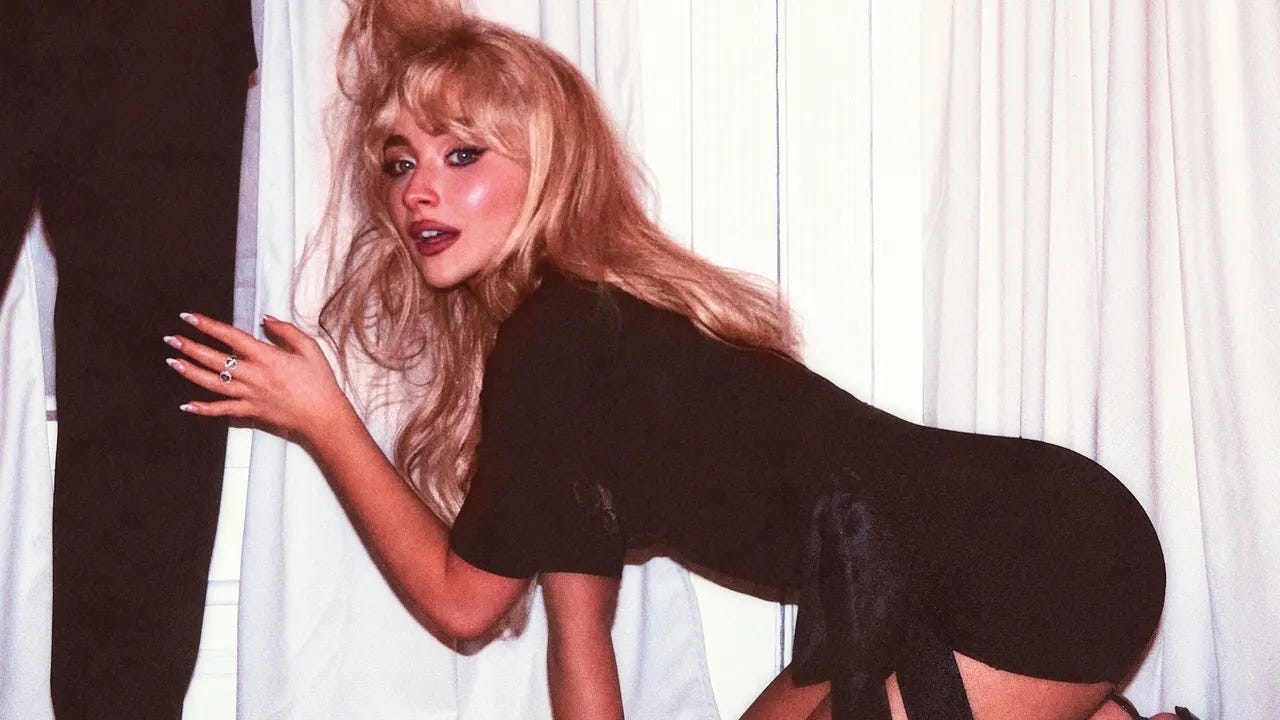
The general take here is that Sabrina is sexually submitting herself to a man. On a public album. Cover your eyes! Also, this is inherently unfeminist. She’s glorifying degradation, playing into male fantasies of female submission (often through violence).
But in my take, I think — it’s a fundamentally unserious cover. My actual reaction was lol, with a lowercase “lol”. But in the context of most album art, all broody portraits or avant-garde shapes, it’s pretty good. My interpretation of it is, “Here I am, totally loyal to you (like a dog). And then you treat me like a dog.” It’s cosmically funny. It’s laughing as a sheen over heartbreak, a woman infusing pop with slapstick.

In 1915, William Ely published this cartoon in a humor magazine. He called it, “My Wife and My Mother-In-Law”. Sometimes you see what you want to see.
I was talking with friends about the latest Taylor Swift album this week. Overall, I think it’s underbaked. Lyrics in Fate of Ophelia like “pledge allegiance to your hands, your team, your vibes” have the corniness of a Triple X movie – in an erudite song alluding to a Shakespearean tale.
But there are other songs where “dumb lyrics” work to convey the emotions of the piece. One of Taylor’s inspirations, going into this, was Gracie Abram’s breakout song That’s So True.
The song That’s So True features lyrics like, “You’re an idiot. Now I’m sure. Now I’m positive, I should go and warn her.” Saying, “Now I’m sure” and then “Now I’m positive” sounds… dumb. But it conveys the emotions of the piece. It conveys this feeling of working up to saying something. The singer is just reacting, at first. “You’re an idiot”. And then she’s digesting. “Now I’m sure.” And then she lets it out. She’s hurt. She’s angry.
In Wi$h Li$t, Taylor sings, “I just want you…Have a couple kids, got the whole block looking like…you”. The public takes this quite literally. “She wants to live in a neighborhood with all rich, white, blonde people”. “Is she advocating for eugenics?” But songs are not literal. The truth of songs, like all art, is in how they make you feel.
“I just want you…Have a couple kids, got the whole block looking like…you”
When I listen to the chorus, I feel – overwhelmed by love, suffused, lightheaded - to the point where I can only think and breathe and talk about “you”. I don’t think the “you” is related to the neighborhood at all. I think it relays the state of the protagonist, pretty accurately.
Back to assumptions. I think there are times when it is okay to assume the worst. For example, it makes sense against people who have a lot of power. Sam Altman’s decisions on OpenAI will be borne by the public. According to psychological studies, the threat of gossip encourages each individual to act more pro-social. There are times when we need to, perhaps overzealously, protect humanity.
But in art? I don’t know. Art is — what people make it. And I think art gives us the space to think differently, think slowly. In All Fours by Miranda July, there is a scene where the protagonist confronts the former lover (Audra) of the man (Davey) she fantasizes about. Initially, Audra repulses her. “Sometimes my hatred of older women almost knocked me over, it came on so abruptly”, she comments on their first encounter. The narrator is thin and obsessed with keeping fit. In contrast, Audra is “big and rounded…squeezed her big arms—apparently my hands couldn’t get enough of all this flesh.” Many readers stop reading here. “This is fatphobic”, they say. The scene I pulled this last quote from, a later scene, is also weird and can trigger disgust. The narrator, who is married, is trying to live her unmet fantasies vicariously through Audra’s accounts of Davey. But ultimately, and I borrow here from Garth Greenwell in The Yale Review, this isn’t about Audra or about Davey. At the start, I feel the narrator’s envy and disgust with Audra. Envy, because Andrea has been with Davey. Disgust, because her boobs now sag and her stomach sags and she looks old. But as Audra narrates, as the protagonist listens, as she gets caught up in it and embodies her desires and frustrations and fears, she’s able to release it. That’s what you miss if you stay tied to the disgust. It’s the earth-shattering beauty of this scene.
This entire book, the narrator is wrestling with standing at the edge of menopause. She’s afraid of her body changing, of becoming undesirable, of losing the ability to desire herself. She projects all this on Audra. And then, as Audra talks about Davey and she falls into a rhythm, she slowly opens herself up. She looks at Audra and Audra looks back. And she realizes Audra, fleshy boobs, sagging skin, unable to provide her own liquid, is beautiful. And so is she.
—
It is not always safe to assume the best. Sometimes people can cause hurt, and it is good to be skeptical. Sometimes those people are famous. But sometimes quick judgement is more about ourselves than the other person. What am I trying to prove? What do I fear?
And what you might miss is a chance to build something with another person. Or, simply, a beautiful piece of art.
—
Another person excitedly knocks at your door. “I just got an idea!”, they say. And maybe you invite them in for tea. Sip slowly. Lean back and ask questions. And listen.